Work

15+ years shipping digital products.

Campaigns, launches, and rebuilds across consumer, tech, and lifestyle.

Old Republic Title (contract), extended into Ascendum
AIProcessGovernance

Case study

Building AI into the production process, not just the output

Role
Sr. Project Manager (Old Republic Title) → UI Design Manager & PM (Ascendum)
Client
Old Republic Title (contract), extended into Ascendum
Team
Product and design teams, HR stakeholders, corporate Governance team
Tools
Claude Code, Figma, Gemini, internal AI-assisted workflow tools
  • 25% shorter project lifecycles
  • 90% success rate on HR chatbot POC
  • 3 product teams onboarded

The challenge

Production processes across creative and development workflows were manual and sequential by default — every project moved through the same steps at the same pace, regardless of whether AI tooling could shorten any of them. With three concurrent product teams and a growing project load, the org needed faster turnaround without adding headcount, and no one had yet mapped where AI could actually remove work rather than just assist with it.

My approach

  1. 1

    Process audit

    I looked at the existing production workflow stage by stage to find where steps were manual, repetitive, and a genuine fit for AI assistance, rather than applying AI broadly and hoping something stuck.

  2. 2

    Tooling and proof of concept

    I designed and implemented streamlined, AI-assisted production processes across the three product teams I directed, and built a proof-of-concept chatbot for internal HR needs as a contained way to test the approach before scaling it further.

  3. 3

    Governance and scale

    I partnered with the corporate Governance team to vet the new process strategies and get them formally adopted rather than left as an informal workaround, which is what made the approach durable enough to carry into my current role leading AI-driven design system development for enterprise clients.

Impact

  • Reduced overall project lifecycles by 25%
  • HR chatbot POC achieved a 90% success rate, leading to corporate-wide approval for implementation
  • The process-first approach to AI adoption carried directly into current work building AI-driven design systems and internal tooling

Any visuals accompanying this case study are recreated for illustration. They represent the shape of the workflow and process changes, not the client's actual internal tools, files, or proprietary documentation.
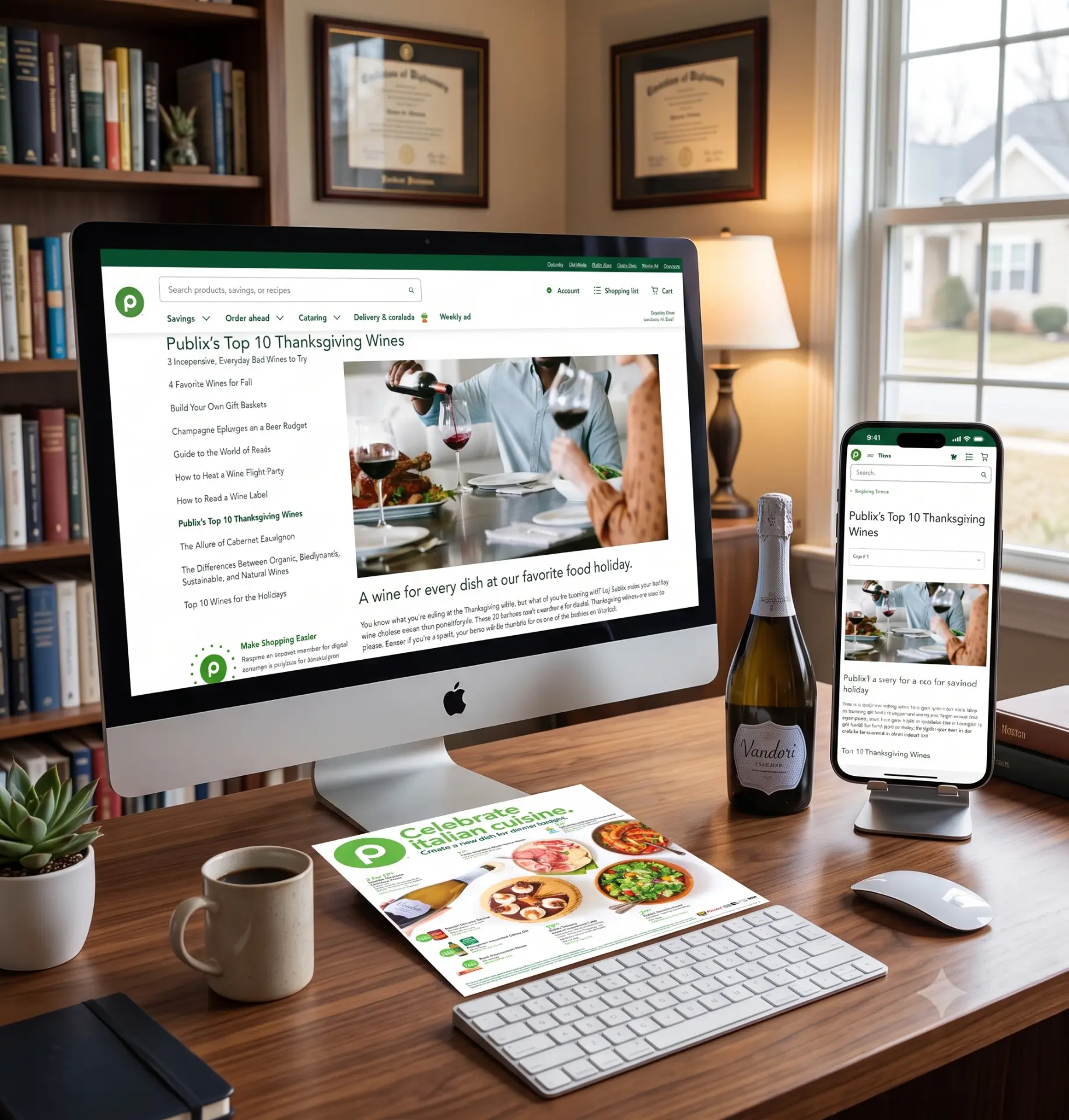
Publix Wine Club experience shown on desktop and mobile alongside printed materials
Publix Super Markets (5+ year engagement)
LoyaltyGrowthUXUI

Case study

Turning a loyalty program into a growth engine

Role
Senior Project & Product Manager
Client
Publix Super Markets (5+ year engagement)
Team
Brand, Creative, Information Systems + agency partner (22Squared)
Tools
Adobe Analytics, Google Analytics, CMS/AEM, email/CRM platform
  • 300,000 members
  • +30% sign-up rate
  • Gold & Silver Addy awards

The challenge

Club Publix's Wine Club existed as a loyalty program, but it wasn't performing like one. Sign-up was clunky, the digital experience felt bolted onto the main site rather than built for it, and membership growth had plateaued well below what the category could support. Wine carries a strong margin and repeat-purchase profile, which made the underperforming program a real opportunity cost, not just an underwhelming feature.

My approach

  1. 1

    Funnel diagnosis

    Before redesigning anything, I mapped the existing sign-up funnel to find exactly where prospective members were dropping off, rather than assuming the whole experience needed to be rebuilt.

  2. 2

    Redesign and integration

    I directed the digital redesign of the Wine Club experience — sign-up flow, member benefits presentation, and ongoing engagement touchpoints — working with Brand and Creative internally and 22Squared externally to make the program feel native to Publix.com rather than a separate microsite.

  3. 3

    Cross-functional governance

    I ran the PMO cadence that kept Brand, Creative, I/S, and the agency aligned on scope, timeline, and the KPI targets we were actually redesigning toward, and managed the budget and resourcing across all four groups.

Impact

  • Grew membership to 300,000, with a 30% increase in sign-up rate
  • Repositioned Wine Club as a scalable growth engine inside Publix's broader loyalty ecosystem rather than a standalone feature
  • Recognized with Gold and Silver Addy awards as part of the broader digital platform work

Any visuals accompanying this case study are recreated for illustration. They represent the shape of the workflow and process changes, not the client's actual internal tools, files, or proprietary documentation.
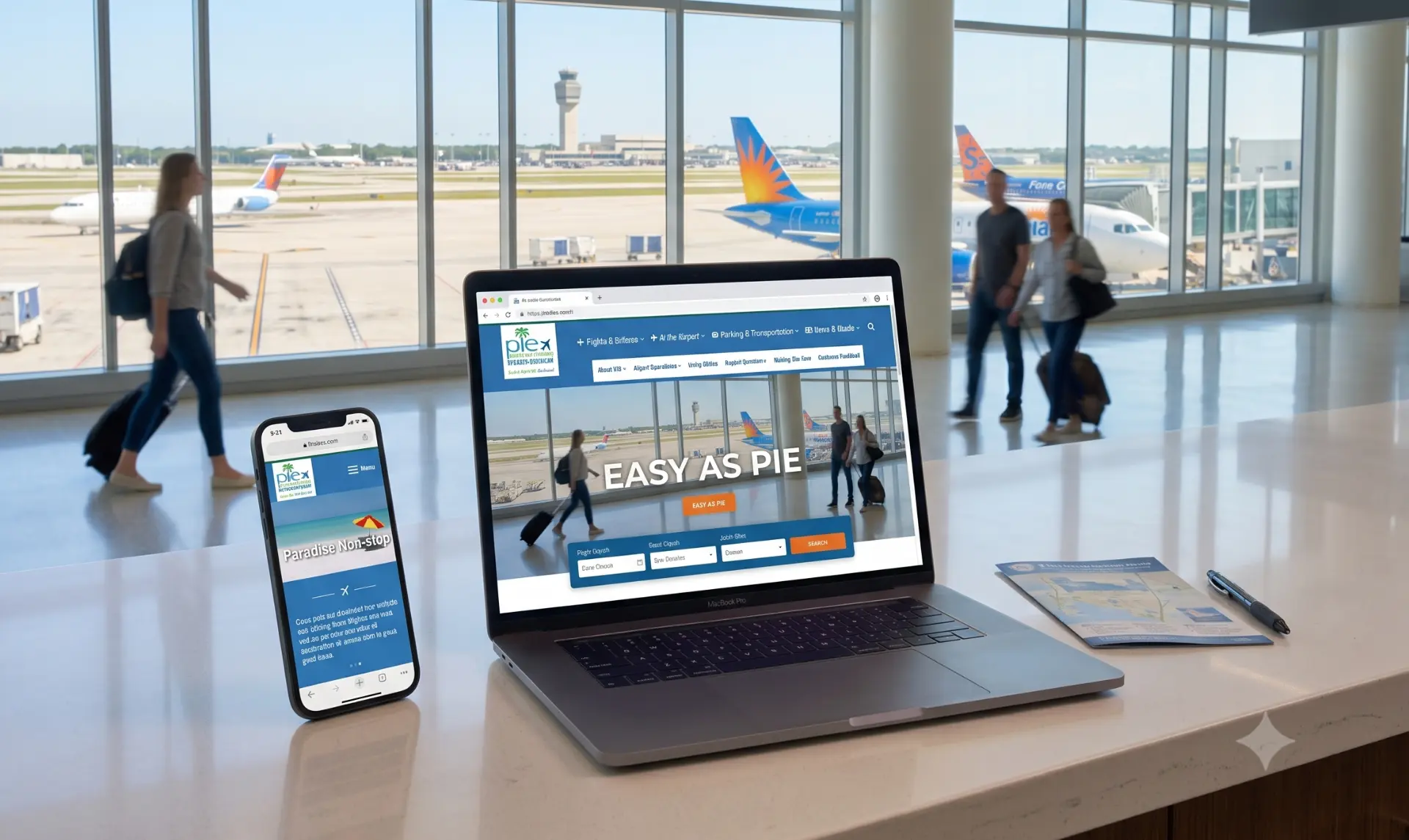
Fly2Pie responsive website shown on laptop and phone in the airport terminal
St. Petersburg/Clearwater International Airport (Fly2Pie)
DigitalUXUICMS

Case study

Turning a decade-old airport site into a real-time passenger tool

Role
Project Manager - Digital
Client
St. Petersburg/Clearwater International Airport (Fly2Pie)
Team
Brand, Creative, Development/Engineering
Tools
AWS, Sitecore, Adobe Analytics, Google Analytics, CMS/AEM, email/CRM platform
  • +30% email list in 90 days
  • 3rd place ACI-NA Excellence Awards
  • ~25% YoY passenger growth

The challenge

St. Petersburg/Clearwater International Airport's website was 10 years old and needed a full overhaul to work on current technology and platforms. The airport wanted a responsive site with a new front and back end they could manage themselves, a CMS that could support ongoing updates, and an email program that could generate emails from a template, collect subscribers, and manage the distribution list. The most technically demanding piece was rebuilding the Arrivals & Departures system so it could feed both the website and the airport's physical terminal monitors.

My approach

  1. 1

    Project strategy and plan

    I ran project strategy sessions to align the client's needs with site capabilities, then recommended platforms, costs, and resourcing for approval before design and development started. I defined scope, schedule, milestones, and the UAT plan needed for a successful launch, and secured client and business-team sign-off on cost estimates along the way.

  2. 2

    Communication cadence

    I led daily and weekly redesign meetings with the creative and development teams, tracking progress through stand-ups and aligning on weekly milestones. I held weekly status calls with the client and ran live reviews at their office to walk through concepts and functional demos for approval.

  3. 3

    Redesign and integration

    I led the creative and development teams in building a responsive UI that surfaced key airport and terminal information, including the Arrivals & Departures functionality passengers needed for their trips.

  4. 4

    Documentation and training

    I produced the Business Requirements Document and a training manual for ongoing maintenance and email creation/deployment, then ran three hands-on sessions to get client administrators self-sufficient on the CMS and email tools.

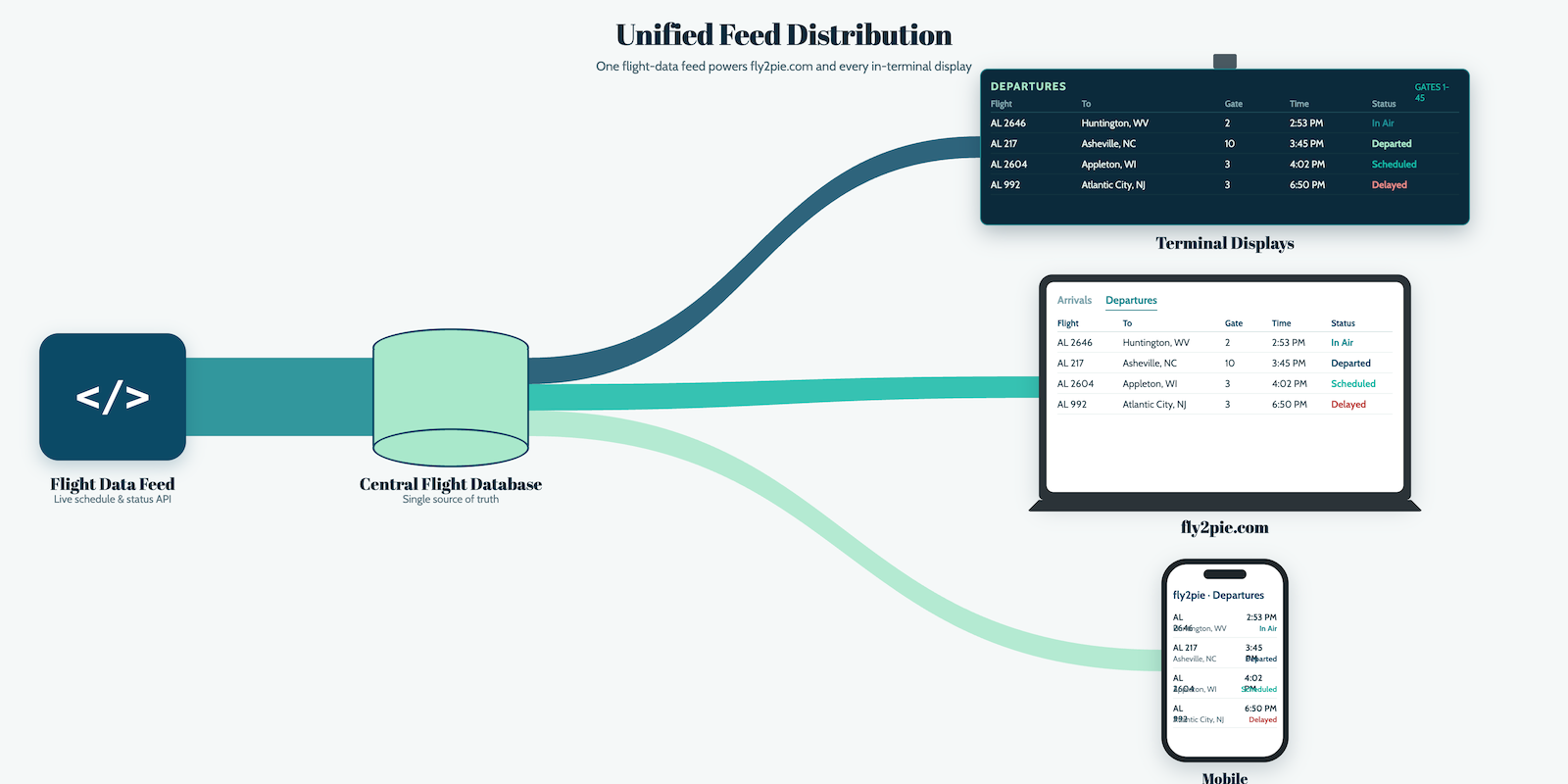
Diagram of one flight-data feed powering fly2pie.com, mobile, and in-terminal departure displays
Arrivals & Departures data flow — one feed powering fly2pie.com and every in-terminal display.
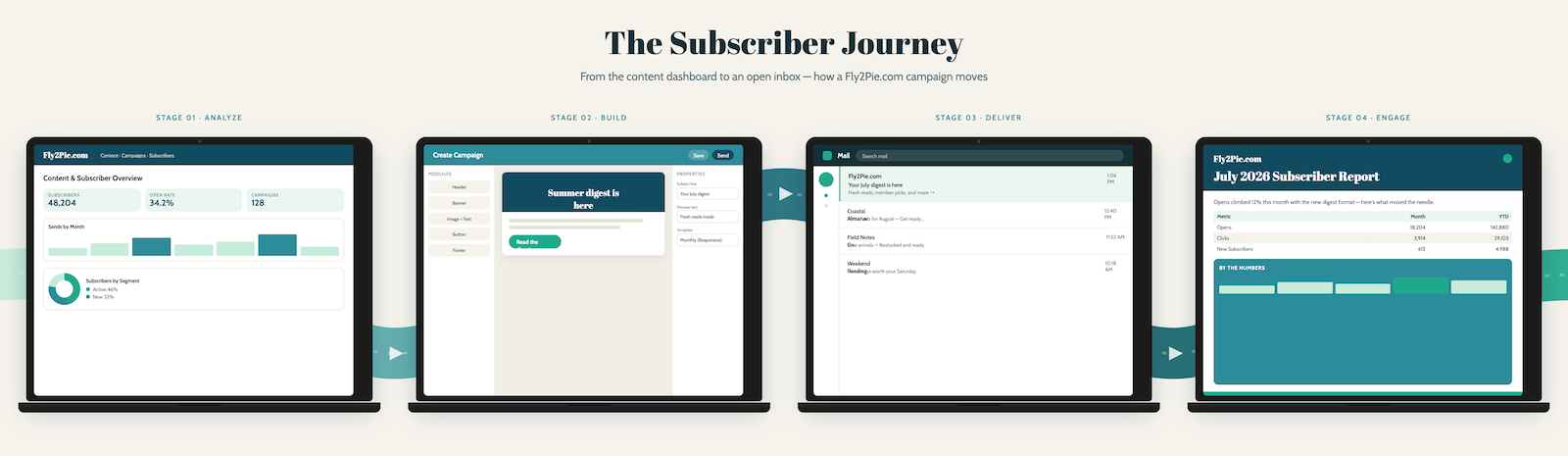
Four-stage subscriber journey from content dashboard to campaign build, delivery, and reporting
CMS + email builder — the subscriber journey from campaign build through delivery and reporting.

Impact

  • Delivered a fully responsive site rebuilt on current platforms, tools, and code standards
  • Built a new email creation and deployment platform inside the CMS, growing the distribution list 30% in the first 90 days
  • Rebuilt the Arrivals & Departures system to feed both the website and the airport's terminal monitors
  • Recognized with 3rd place in the ACI-NA Excellence Awards for Fly2Pie.com
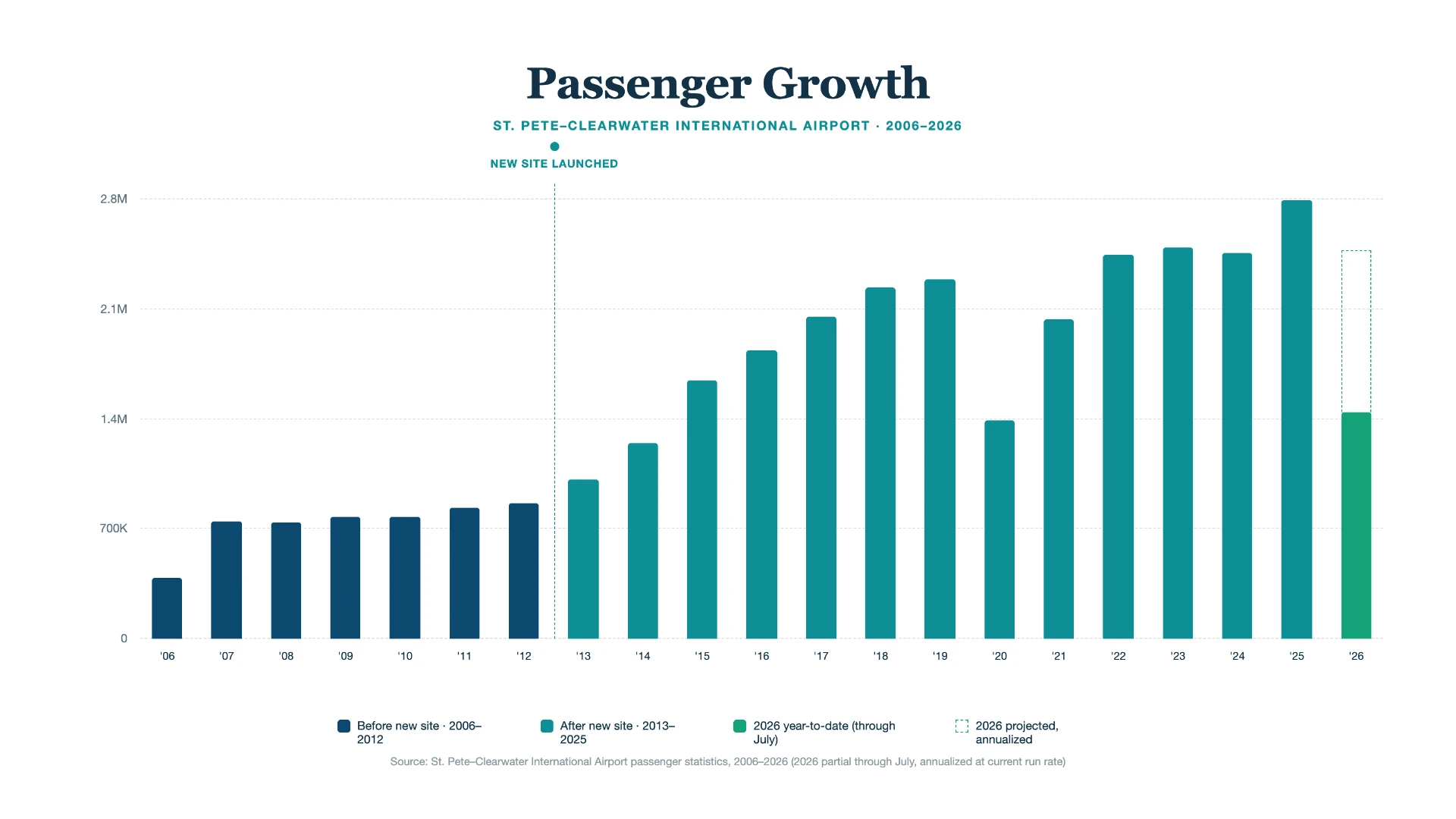
  • Airport-wide passenger traffic grew from 800,000+ in 2012 to 1.1 million in 2013, averaging 25% YoY growth from 2012–2022 (excluding 2020) — broader business context the redesigned digital platform was built to support
Passenger growth at St. Pete–Clearwater International Airport from 2006 to 2026, with the new site launch marked in 2013
Passenger growth (2006–2026) — the new site launched in 2013, framed as business context rather than attributed lift.

Any visuals accompanying this case study are recreated for illustration. They represent the shape of the workflow and process changes, not the client's actual internal tools, files, or proprietary documentation.
Universal Destinations & Experiences
Design SystemProductMobile

Case study

Getting Universal: unifying theme parks onto one global digital system

Role
Project & Product Manager
Client
Universal Destinations & Experiences
Team
Engineering, UX, and Marketing, coordinated across the US and Japan
Tools
Design system/component tooling, JIRA, Flutter (mobile)
  • 1,000+ pages converted
  • Up to 40% reduction in budget and hours
  • 106M+ annual guests supported
  • +17% conversion, +30% app NPS

The challenge

Universal's digital properties had grown up independently across Universal Studios Hollywood, Universal Studios Orlando, Universal Japan, and the newly opening Epic Universe park. Each had its own versions of maps, calendars, and page templates, which meant every enhancement — a new ticketing flow, a new wayfinding feature — had to be re-solved separately for each park, per platform. The long-term digital strategy called for something more ambitious: a single system that connects park sites, hotels, reservations, mobile food ordering, and geo-targeted wayfinding across all four markets, rather than four parallel one-off builds.

My approach

  1. 1

    Foundation: an atomic component system

    Rather than a one-time redesign, I directed the build of the Global Digital System (GDS) on an atomic component methodology — base components that assemble into reusable page templates, so new pages could be built from an existing library instead of custom-coded every time. This foundation made it possible to convert 1,000+ pages across all four markets to a single system.

  2. 2

    Interconnected sub-systems

    With the component system in place, I owned the roadmap for three initiatives that plugged directly into it: wayfinding maps redesigned to highlight each park's new themed "Land" zones plus an entirely new map built from scratch for Epic Universe; five new calendar types (ticketing, hotel, food ordering, reservations, and event planning) so each transactional flow had a purpose-built calendar instead of one generic type stretched to fit; and the mobile app's move to Flutter, improving content deployment performance and giving users a faster, more efficient app.

  3. 3

    Cross-regional delivery

    I managed a cross-functional Scrum team spanning the US and Japan, running backlog grooming, sprint planning, and release execution across time zones and market-specific localization requirements.

Impact

  • Converted 1,000+ pages across Hollywood, Orlando, Japan, and Epic Universe onto the unified GDS
  • Standardized page templates delivered up to a 40% reduction in budget and resource hours on subsequent projects — typical project timelines dropped from roughly 4 months to 2–2.5 months, since new work assembled from the existing component library instead of being built from zero
  • Supports a platform serving 106M+ annual guests across Hollywood, Orlando, Japan, and Epic Universe
  • Contributed to a 17% increase in B2C/B2B2C conversion and a 30% boost in mobile app NPS
  • Established the map, calendar, and mobile foundations needed to support Universal's longer-term plan of connecting park, hotel, reservation, and food-ordering experiences into one system

Any visuals accompanying this case study are recreated for illustration. They represent the shape of the component system and program structure, not Universal's actual design files, code, or internal documentation.